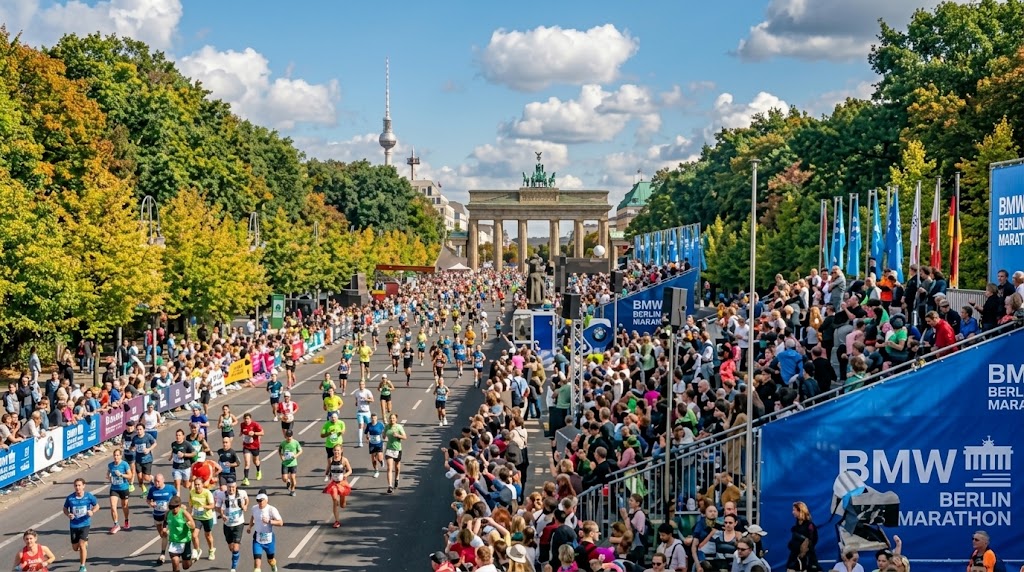
The Berlin Marathon 2026 took place on Sunday, September 27, 2026, bringing thousands of runners to the German capital for the 52nd BMW BERLIN-MARATHON. The race featured a fast elite field, a flat 42.195-kilometer course, six runner start waves and a dramatic women’s race in which Tigst Assefa narrowly missed the marathon world record.
Guye Adola won the men’s race in 2:02:50, while Tigst Assefa won the women’s race in 2:11:04. Assefa remained on world-record pace deep into the race before slowing in the closing stages.
This complete Berlin Marathon 2026 guide covers the race date, start times, entry fee, lottery, route, cutoff rules, Marathon Expo, race-day transportation, results and practical information for runners and spectators.
Berlin Marathon 2026 at a Glance
| Detail | Information |
|---|---|
| Event | 52nd BMW BERLIN-MARATHON |
| Date | Sunday, September 27, 2026 |
| Location | Berlin, Germany |
| Distance | 42.195 km |
| Runner starts | From 8:45 a.m. in six waves |
| First runner wave | 8:45 a.m. |
| Final runner wave | 10:27 a.m. |
| Start area | Straße des 17. Juni |
| Finish | Near the Brandenburg Gate |
| Time limit | 6 hours 15 minutes |
| Official entry fee | €205 |
| Marathon Expo | Tempelhof Airport |
| Organizer | SCC EVENTS |
| Men’s winner | Guye Adola, 2:02:50 |
| Women’s winner | Tigst Assefa, 2:11:04 |
The official organizer confirmed six marathon starting waves, beginning at 8:45 a.m. and continuing through 10:27 a.m. The start is on Straße des 17. Juni between the Brandenburg Gate and the Kleiner Stern.
When Was the Berlin Marathon 2026?
The BMW BERLIN-MARATHON 2026 was held on Sunday, September 27, 2026.
The event weekend included several races and activities, with the main marathon serving as the weekend’s headline event. More than 84,000 participants across the various BMW BERLIN-MARATHON weekend events were expected, including more than 56,000 marathon participants.
The main marathon started in waves rather than sending every runner across the start line at the same moment.
The six runner waves were scheduled as follows:
- 8:45 a.m. — Start Wave 1, Blocks A, B and C
- 9:05 a.m. — Start Wave 2, Blocks D and E
- 9:33 a.m. — Start Wave 3, Blocks F and G
- 10:02 a.m. — Start Wave 4, Block H
- 10:12 a.m. — Start Wave 5, Block J
- 10:27 a.m. — Start Wave 6, Block K
The organizer assigned runners to start blocks according to their submitted best or target time.
Berlin Marathon 2026 Start Time
The first marathon runners started at 8:45 a.m. local Berlin time.
The elite wheelchair and handbike competitions started earlier:
- 8:20 a.m. — Top handbikers
- 8:26 a.m. — Elite wheelchair athletes
- 8:29 a.m. — Additional handbike and wheelchair starts
- From 8:45 a.m. — Marathon runners in six waves
The official start area was on Straße des 17. Juni between the Brandenburg Gate and Kleiner Stern.
The exact time a runner crosses the starting line depends on their assigned wave. This distinction is important because the 6-hour-15-minute time limit is calculated from the participant’s crossing of the starting mat, rather than simply from the first gun time.
Berlin Marathon 2026 Entry and Lottery
Standard participation for the 2026 BMW BERLIN-MARATHON was allocated through the official lottery system.
The lottery registration period ran from September 25 to November 6, 2025. Runners who did not enter during the published lottery period could not normally obtain a standard lottery entry afterward.
Other official participation routes can include charity places and authorized tour-operator packages, depending on the event’s rules and availability.
For future editions, runners should always check the official BMW BERLIN-MARATHON registration information rather than relying on dates from an earlier year. Entry windows, prices, partner places and participation rules can change.
Berlin Marathon 2026 Entry Fee
The official participation fee for the 2026 BMW BERLIN-MARATHON was €205.
According to the organizer, the package included race entry, timing, a four-day public-transport ticket for fare zones A, B and C, pacemakers, the official marathon app with tracking options, refreshments, course security, a finisher medal and a personalized finisher certificate. The package also included a reusable finish-line poncho, with a clothing-bag option available for an additional €5.
The entry fee therefore covered more than the race itself. Participants also received several race-day and event-weekend services.
Berlin Marathon Eligibility and Rules
Participants in the marathon must meet the organizer’s eligibility requirements.
The event has a strict official time limit. Runners who exceed the permitted time are required to leave the official course and are transported toward the finish rather than continuing the official competition.
Walking is permitted under the event rules, but runners still need to remain within the official time requirements.
Participants should also follow their assigned start block and the instructions of race officials and course volunteers.
Because marathon conditions can change, runners should review the official race information and their individual start documents before race day.
Berlin Marathon 2026 Time Limit and Cutoff
The official marathon time limit was 6 hours 15 minutes.
There was also a specific course cutoff:
15:40 at approximately kilometer 33.
Participants who were outside the permitted schedule had to leave the official route and were transported to the finish using the event’s broom bus service. The official finish closure was scheduled for 5:00 p.m.
This makes cutoff planning particularly important for runners expecting to finish near the six-hour mark.
A runner should not calculate the race solely from the first 8:45 a.m. start. The relevant time limit begins when that individual crosses the start mat.
Berlin Marathon 2026 Route
The Berlin Marathon covers the standard marathon distance of 42.195 kilometers through the German capital.
The start is on Straße des 17. Juni, while the spectacular finish takes place near the Brandenburg Gate.
The course passes through several parts of central Berlin and gives runners views of major city landmarks. The route is famous for its relatively flat profile, making it attractive to runners who want to pursue fast marathon times.
The official course information should always be checked before the event because road layouts and operational arrangements can change.
Major Areas and Landmarks Along the Route
Depending on the exact course configuration, runners pass through or near several recognizable parts of Berlin, including:
- Tiergarten
- Moabit
- Reichstag area
- Friedrichshain
- Strausberger Platz
- Potsdamer Platz
- Kurfürstendamm
- Central Berlin
- Unter den Linden
- Brandenburg Gate
The finish near the Brandenburg Gate provides one of the most recognizable marathon finishing locations in international road racing.
Why Is the Berlin Marathon Course So Fast?
The Berlin Marathon is widely associated with fast marathon performances because of its flat urban course and favorable racing conditions.
The course does not guarantee a personal best, however. Runners still have to manage pacing, nutrition, hydration, weather, crowd density and fatigue.
The first kilometers can also be crowded, particularly for runners starting in large waves. Trying to run faster than planned simply to make up time during the opening section can create problems later in the race.
For example, a runner targeting a four-hour marathon needs an average pace of roughly 5:41 per kilometer. The flat course can make consistent pacing easier, but the runner still needs sufficient training and a realistic race strategy.
Berlin Marathon 2026 Marathon Expo
The MARATHON EXPO by BRITA was held at Tempelhof Airport, Platz der Luftbrücke 5, 12101 Berlin.
The 2026 Expo was open from September 24 through September 26:
- Thursday, September 24: 3 p.m. to 8 p.m.
- Friday, September 25: 10 a.m. to 8 p.m.
- Saturday, September 26: 9 a.m. to 7 p.m.
Entry to the Expo itself was free.
The Expo served as the main location for race-material collection and also featured exhibitors, running products, event information and official merchandise.
Race Material Pickup
Runners had to collect their race materials at the Expo during the official pickup period.
The organizer provided optional time slots to help reduce waiting times. Participants were advised that Thursday or Friday morning could be less crowded, while Friday afternoon and Saturday could become busy.
The race-material pickup location was:
Tempelhof Airport
Platz der Luftbrücke 5
12101 Berlin
Participants should check their individual race documents for all required identification and start information.
Leaving bib collection until the final hours can add unnecessary stress before a marathon, particularly when the Expo is busy.
Poncho or Clothing Bag?
The 2026 event gave participants two finish-area options.
The standard package included a reusable finish-line poncho. Alternatively, runners could select a clothing bag for a €5 fee.
The clothing-bag option allowed runners to use the designated clothing-drop system, while the poncho option was designed for participants who did not need to leave clothing at the start area.
This decision can affect race-morning planning.
Runners who want to minimize post-race waiting may prefer the poncho arrangement, while participants who need access to personal clothing after finishing may find the clothing-bag option more useful.
Getting to the Berlin Marathon Start
The organizer recommends using public transportation.
For participants, the race bib functioned as a public-transport ticket in fare zones A, B and C from September 24 through September 27.
Public-transport stops serving the start and finish areas included:
- Brandenburger Tor
- Bundestag
- Unter den Linden
- Potsdamer Platz
- Berlin Hauptbahnhof
Race-day road closures can change normal travel patterns, so participants should allow additional time and check current transport information before leaving their accommodation.
Berlin Marathon 2026 Results
The 2026 Berlin Marathon produced an Ethiopian double, with Guye Adola winning the men’s race and Tigst Assefa winning the women’s race.
Men’s Elite Results
| Position | Runner | Country | Time |
|---|---|---|---|
| 1 | Guye Adola | Ethiopia | 2:02:50 |
| 2 | Gemechu Dida | Ethiopia | 2:03:19 |
| 3 | Gabriel Geay | Tanzania | 2:03:59 |
| 4 | Getaneh Molla | Ethiopia | 2:04:55 |
| 5 | Selemon Barega | Ethiopia | 2:04:58 |
World Athletics reported Adola’s winning time as 2:02:50, a personal best and his second Berlin Marathon victory.
Women’s Elite Results
| Position | Runner | Country | Time |
|---|---|---|---|
| 1 | Tigst Assefa | Ethiopia | 2:11:04 |
| 2 | Bedatu Hirpa | Ethiopia | 2:16:53 |
| 3 | Dera Dida | Ethiopia | 2:16:55 |
| 4 | Bekelech Gudeta | Ethiopia | 2:18:58 |
| 5 | Alemitu Tariku | Ethiopia | 2:19:01 |
World Athletics reported Assefa’s 2:11:04 as the winning time and the third-fastest women’s marathon performance in history at the time of the race.
For complete participant results, certificates and official race records, runners should use the official BMW BERLIN-MARATHON results platform.
Tigst Assefa Misses the World Record
One of the biggest stories from the Berlin Marathon 2026 was Tigst Assefa’s attempt to break the women’s marathon world record.
Assefa remained on record pace deep into the race. World Athletics reported that she was still in contention around the 40-kilometer mark before slowing during the closing stages.
She eventually finished in 2:11:04, winning the race but missing Ruth Chepngetich’s world record of 2:09:56.
Assefa’s performance was nevertheless a major result, and the winning time placed her among the fastest women ever recorded over the marathon distance.
Guye Adola Wins His Second Berlin Marathon
Guye Adola produced the men’s winning performance in 2:02:50.
The Ethiopian runner broke away from the leading group during the later stages and built a decisive advantage. World Athletics reported that he reached 30 kilometers in 1:26:57 before extending his lead later in the race.
Adola had previously won the Berlin Marathon in 2021. His 2026 victory therefore gave him a second Berlin title.
Gemechu Dida finished second in 2:03:19, while Gabriel Geay of Tanzania took third in 2:03:59.
What Happened to Sabastian Sawe?
Sabastian Sawe, the defending Berlin champion and men’s marathon world-record holder, did not compete in the 2026 race because of injury.
His withdrawal changed the men’s elite field before race day and removed one of the major contenders from the competition.
The event organizer had previously listed Sawe among the expected stars before his withdrawal.
Live Tracking and Official Results
The official BMW BERLIN-MARATHON platform provides race results and live-tracking information.
Participants can use the event’s digital services to follow race information, while spectators can use tracking tools to monitor individual runners.
For an individual runner’s official result, certificate or race record, the organizer’s results page is the most appropriate source.
Third-party leaderboards can be useful for news coverage, but runners looking for an official finishing time should check the organizer’s own database.
Tips for Runners Preparing for Berlin
A successful marathon requires more than simply knowing the route.
Practice Your Race-Day Nutrition
Use training runs to practice the gels, sports drinks and other nutrition products you expect to use during the marathon.
Race day is not the ideal time to experiment with an unfamiliar fueling strategy.
Avoid an Aggressive Start
The excitement of the Berlin start can encourage runners to move faster than their planned pace.
Try to keep the opening kilometers controlled. A small amount of time gained early is rarely worth a major slowdown later.
Plan Your Expo Visit
Know where Tempelhof Airport is before traveling to Berlin.
Check your race documents, identify the required pickup process and allow enough time for crowds.
Plan Your Transport
Because Berlin experiences extensive race-related road closures, your normal journey may not work exactly as expected on race morning.
Public transportation is recommended by the organizer, and participants had public-transport access included with their bib during the event period.
Respect the Cutoff
If your expected finish is close to the six-hour limit, calculate your pace carefully.
Remember that the event also has a specific kilometer-33 cutoff at 3:40 p.m.
Tips for Spectators
Watching the Berlin Marathon can be easier when you choose your locations before race day.
Instead of trying to cross the entire city, spectators can select one or two sections of the course and use public transportation between suitable viewing points.
Popular areas around the central route can become crowded, particularly close to the start and finish.
The Brandenburg Gate is one of the most recognizable places to experience the final stages, but spectators should arrive with enough time to account for security measures, barriers and pedestrian restrictions.
Berlin Marathon Travel Guide
International runners should plan their Berlin trip around three main elements:
Accommodation: Book a location with convenient access to public transportation rather than focusing only on proximity to the finish.
Expo: Leave enough time for Tempelhof Airport and race-material pickup.
Race morning: Check transport information and leave earlier than you would for a normal day in Berlin.
A simple travel plan can reduce unnecessary stress during race week.
Runners should also avoid making major sightseeing plans immediately before the marathon. Walking long distances around the city can add fatigue during the final days before the race.
What to Know About the Berlin Marathon Course
The Berlin course is famous for its flat profile and fast racing conditions, but runners should still prepare for a long urban race.
Crowds can be significant, particularly around major landmarks. The course also contains turns and sections where runners need to manage their position within the field.
A good race plan should therefore combine:
- Target pace
- Hydration strategy
- Fueling schedule
- Weather contingency
- Start-wave awareness
- Transport planning
- Cutoff awareness
The flat profile is an advantage for many runners, but preparation remains essential.
What Happens After the Berlin Marathon?
The finish area provides runners with several services, including refreshments, medical support and the finish-line experience.
The official package also included a finisher medal, personalized certificate and either the included poncho or the optional clothing-bag arrangement.
Participants who complete the race within the official requirements can access their official result and certificate through the event’s results platform.
When Is the Next Berlin Marathon?
The 2026 race has now taken place. Runners interested in a future edition should monitor the official BMW BERLIN-MARATHON registration and lottery information.
Do not assume that the next lottery will use exactly the same dates, entry fee or conditions as the 2026 event.
The organizer publishes registration information for each edition separately, so checking the official website is the safest way to confirm future entry requirements.
Frequently Asked Questions
What date was the Berlin Marathon 2026?
The BMW BERLIN-MARATHON 2026 took place on Sunday, September 27, 2026.
What time did the Berlin Marathon 2026 start?
The first marathon runner wave started at 8:45 a.m. local time. Six runner waves continued through 10:27 a.m.
How much was the Berlin Marathon 2026 entry fee?
The official participation fee was €205.
What was the Berlin Marathon 2026 time limit?
The official time limit was 6 hours 15 minutes, measured from when the participant crossed the starting mat. The event also had a kilometer-33 cutoff at 3:40 p.m.
Where was the Berlin Marathon Expo held?
The MARATHON EXPO by BRITA was held at Tempelhof Airport, Platz der Luftbrücke 5, Berlin.
Who won the Berlin Marathon 2026?
Guye Adola won the men’s race in 2:02:50, while Tigst Assefa won the women’s race in 2:11:04.
Did Tigst Assefa break the women’s marathon world record?
No. Assefa finished in 2:11:04 after slowing in the closing stages. The world record of 2:09:56 remained intact.
How many start waves were there for marathon runners?
There were six runner start waves, beginning at 8:45 a.m. and ending with the final wave at 10:27 a.m.
Where does the Berlin Marathon finish?
The race finishes near the Brandenburg Gate in central Berlin.
Where can I check official Berlin Marathon results?
The official BMW BERLIN-MARATHON results platform provides race results, certificates and related participant information.
Final Takeaway
The Berlin Marathon 2026 delivered another major day of marathon racing in the German capital.
Guye Adola won the men’s race in 2:02:50, while Tigst Assefa won the women’s race in 2:11:04 after a dramatic attempt at the world record.
For participants, the key practical details were the €205 entry fee, six runner start waves, the 6:15 time limit, the 3:40 p.m. kilometer-33 cutoff and race-material pickup at Tempelhof Airport.
For anyone planning to run a future edition, the most important step is to monitor the official BMW BERLIN-MARATHON registration information because lottery dates, fees and participation rules can change from one year to the next.